Do College Degrees Pay Off?

In addition to older blog posts, I just learned of this study by the Texas Post-Secondary Commission, finding that yes, bachelor's, associate's, and even certificates do pay off:

https://www.texas-psc.org/summary 

Of note, they analyzed close to a million graduates' records who enrolled in 2008-09 (or later), and ten years later, they have earned a lot more money than their counterparts who did not go to college. It is also important that the program of study makes a large difference in graduates' income, with "Engineering and Architecture," "Business and Economics," and "Security and Protective Services" programs being the highest-earning bachelor's degrees in the study (see: https://www.texas-psc.org/bachelors/programmatic-cohorts).

Unfortunately, the publication had no other outcomes, such as unemployment levels, family stability, overall health, etc., which are also highly correlated with college achievement. More of these can be found here: https://drolivaslujan.blogspot.com/2025/09/

Thank you for reading!

Why Can’t I Choose My Teammates in Your Classes?

Students often ask me why they can’t pick their own teammates in my classes. In many classes, choosing your own group is common, and I used to prefer it too. But over time, I noticed that most students select friends or people who seem similar to them. This is a normal human tendency—called similarity or affinity bias—but it can accidentally create cliques or limit opportunities to meet new people or work adequately with individuals that are different from us.

To give students a more valuable learning experience, I moved to an evidence‑based system where I assign teams. This lets you work with classmates you might not interact with otherwise. Diverse groups—whether in gender, background, major, skills, or perspectives—better mirror real workplaces. In most jobs, you don’t get to choose your early‑career teams, and you will often collaborate with people who have very different experiences from yours. Practicing this in college helps you become a stronger, more adaptable teammate in your professional career.

Why I Use Assigned, Diverse Teams

In this course, I build teams using specific demographic and behavioral criteria rather than allowing self‑selection. Research shows that diverse groups outperform more homogeneous ones on complex tasks and that assigned teams often share work more fairly, avoid “social loafing,” learn more from one another, and benefit from a wider mix of ideas.

My Goal

My goal is to prepare you for professional environments by giving you practice working across differences. By collaborating with a broad range of peers, you develop important communication, teamwork, and conflict‑management skills that employers value highly.

The Research Foundation

Reduced "Social Loafing": Research shows that instructor-assigned groups often exhibit higher accountability than friend-based groups, leading to more equitable work distribution (Maguire & Keceli, 2023).

Knowledge Spillovers: Interacting with peers from different demographics and disciplines has been shown to improve individual learning outcomes and exam performance (Hansen, Owan, & Pan, 2015).

Collective Intelligence: A team’s success is driven by “Collective Intelligence”—a factor enhanced by social sensitivity and a wide range of perspectives rather than just the individual IQ of its members (Janssens, Meslec, & Leenders, 2022).

References

Chapman, K. J., Meuter, M. L., Toy, D., & Wright, L. K. (2006). Can’t we pick our own groups? The influence of group selection method on group dynamics and outcomes. Journal of Education for Business, 81(3), 150–157. https://doi.org/10.1177/1052562905284872 

Dachner, A. M., & Beatty, J. E. (2023). A selected review of exemplary diversity articles published in the Journal of Management Education. Journal of Management Education, 47(2). https://doi.org/10.1177/10525629231178798 

Hansen, Z., Owan, H., & Pan, J. (2015). The impact of group diversity on class performance: Evidence from college classrooms. Education Economics, 23(2), 238-258. https://eric.ed.gov/?id=EJ1048197

Janssens, M., Meslec, N., & Leenders, R. T. A. J. (2022). Collective intelligence in teams: Contextualizing collective intelligent behavior over time. Frontiers in psychology, 13, 989572. https://doi.org/10.3389/fpsyg.2022.989572

Maguire, D., & Keceli, Y. (2024). The impact of formation and diversity on student team conflict. Active Learning in Higher Education, 25(3), 409-423. https://doi.org/10.1177/14697874221144998 
 

Students' Comments, December 2025

The following are some of the comments left by students who took my classes in the Fall of 2025. They knew that (1) their names would not be revealed, and that (2) I would not read them before I reported final grades. In other words, they did not post this to flatter me and receive a higher grade!

Dr. Olivas–Lujan is an excellent professor who seems to care about the material and the students.

I really enjoyed this course. While it was challenging at times, there profession [sic] provided clear instructions and feedback to ensure student success. This course was well put together and enjoyable for that reason.

Dr. O has provided excellent feedback regarding assignments and where we can improve our work. He is understanding and supportive of his students, and responded promptly to questions about coursework.

The feedback was beneficial, and I can tell Dr. Olivas–Lujan took the time to leave personalized feedback. The announcements also were helpful to keep us on track. 

During this course it has made me reflect on people and managing, Dr. Miguel Olivia's–Lujan has done an amazing job with this course.

Organizational Design and change management were very insightful courses especially when mixed with these practical virtual simulations within the Harvard University . The Learning materials were very challenging and high level . For the first time of my life , I have discovered a Doctor who really deserves the title of Doctor. He is a very savvy scholar and intellectual with a good sens of humility and empathy.

We are at the end of the semester and one thing I'm sure about , I will miss Dr O!

Dr. O truly cares and instructs content that is translatable to the professional environment,

He was always answered questions and emails in a timely manner and was willing to help when needed.  
He was very easy to get in contact with. He had good assignments...

He was always there to help

I think the team projects were good to work with people

He is very easy to get ahold of, and he is always willing to assist students with issues.

I think all aspects of this class will be utilized in my everyday happenings and I appreciate how well the Professor taught the class and was very helpful whenever we needed him.

Dr O provided a lot of instructions and was always available to assit.

Love this course 

Professor Lujan's course is very well structure to follow. It is very beneficial to help my learning. I've learned more regarding hazards that were located around a workplace.

He was always there to help.

I liked the group projects and I think they were fun

The most beneficial aspects for me were the discussions and presentations created by students. Many classes feel like there is an immense amount of information trying to be crammed into a week, and then the next week includes all new information, leading to last week's assignments to be forgotten quick. Using the discussions to reflect on information that we learned before helped the topics really set into my brain. The presentations included real world examples that helped me realize the necessity of each topic in workplaces.

I thought the course was very organized. The discussions with our groups was beneficial to me because I got to emphasize what I learned while also understanding what my group learned.

I think the DB [discussion boards] were beneficial. 

I felt that the class was well structured for learning. I don't think there's anything that I would change in the course to make more beneficial.  

I think as an online student, this class is very well designed the way it is  

Loved the course  

There is nothing to improve, I believe, everything is perfect.

Of course, there was a couple of students who left negative comments, but that's the nature of the job. The comments above really make my day (my year!) and motivate me to give my students even more attention and help their professional preparation and growth! 

Gemini-generated image of "a happy university professor in his 50s"

Catholic social scientists reframe perspective on retirement

Here is a very interesting article based on a recent presentation I made at the 2025 Annual Conference of the Society of Catholic Social Scientists in Steubenville, OH (Franciscan University of Steubenville). 


Catholic social scientists reframe perspective on retirement: “Retiring for Eternity: Planning Based on Social Science and Catholic Social Thought” was one topic at the Society of Catholic Social Scientists’ annual conference.

Do College Degrees Increase Happiness?

This is a question that many in our society are asking. For many years, it seemed as though education was the path to a successful and happy life, but these days there are many who question whether college degrees can deliver.

In a previous post, I posted a couple of graphs that show how income and education are very strongly correlated and education is also strongly linked to having retirement accounts (e.g., 401(k)s, 403(b)s, IRAs, etc.). In this post, I want to point to a recently published study that tracked 50 years of US data.

The journal article is written in fairly technical language (as appropriate for a social scientific publication) and includes several "twists and turns." But the overall message is that, compared to individuals without undergraduate (or graduate) degrees, those who earn a university degree tend to report higher levels of happiness.

There are a few nuances. For example, happiness levels went down after the COVID-19 pandemic. Occupation and income, while strongly related to education, are different and may have independent effects on life satisfaction levels. And there have been a couple of time periods in which undergraduate degree holders reported higher levels of happiness than their counterparts wih graduate degrees (that is, masters and doctoral degrees). But most of the time, the pattern holds: the more education, the more satisfaction with life.

Overall, this only reinforces (at least in my mind) the idea that earning a college or university degree increases the chances of having a satisfactory and productive life. As I wrote in the earlier post, expensive as it may be, higher education is very much worth the investment!

What Motivates Expatriates to Extend their Life Abroad?

On June 30th, I had the privilege (and pleasure!) of moderating this IHRM (International Human Resource Management) webinar. I hope you enjoy it too!


An article that explains this presentation in a more formal/scientific package is available at: https://www.sciencedirect.com/science/article/pii/S1053482224000640


A Tough Conversation: On Final Grades and Moving Forward

The semester has officially ended, and final grades have been submitted. For many of you, this is a moment of satisfaction, reflecting a semester of hard work. For others, I know the final grade is a deep disappointment.

If you are reading this because you received a failing grade, I want to address you directly. I understand the frustration that can come with this outcome. It is natural to seek a different result, and I have received several emails asking if there is anything that can be done to change the grade.

This post is my attempt to answer that question transparently and to provide a path forward. I am not writing this out of a lack of care; I am writing it out of a commitment to fairness and the academic integrity of our program.

Why I Cannot Change Your Grade

The final grade in this course is not a judgment of your potential; it is a direct reflection of your performance on the assignments, exams, and other graded activities as outlined in our syllabus or learning management system. To retroactively alter a grade for one student would be unfair to every other student in the class—those who met the deadlines, those who juggled the same competing priorities and managed to pass, and even those who may have been just a few points shy of a higher grade.

The course policies and deadlines were the same for everyone. Offering a "do-over" to one student after the semester has ended would fundamentally undermine the structure of the course and devalue the efforts of all other students. The time for completing the work was during the semester, not after the final grades have been calculated and submitted. In most of my courses, I offer bonus points and extra credit, which I trust you have noticed.

A Moment for Honest Reflection

I do not enjoy reporting a failing grade. My goal is for every student to master the material and succeed in my class and in the future. However, when I look at the records of students who did not pass, most of the reasons tend to be very similar. They often include:

  • A pattern of missed deadlines: In the world of business, meeting deadlines is a critical competency. Our course was structured to help you build this skill.

  • Last-minute or incomplete submissions: Procrastination is a significant barrier to success in an advanced course. The material requires sustained engagement, not a last-ditch effort.

  • Subpar teamwork: Most of my classes include teamwork assignments because this is the way businesses work. Teamwork evaluations help me identify performance levels in this aspect.

  • A lack of communication: When challenges arose during the semester, the time to discuss them was then, not now.

If you find yourself in this position, I urge you to resist the temptation to place blame externally. Instead, take this as a serious opportunity for self-assessment. What were the real obstacles to your success in this course? What choices did you make regarding your priorities and time management? An honest answer to these questions is the first step toward ensuring this does not happen again.

Your Path Forward

A failing grade is just a stumble, not a permanent disqualifier. You are in a rigorous academic program, and challenges are a part of that journey. Your resilience in the face of this obstacle is what will define you, not the grade itself.

I strongly encourage you to connect with your academic advisor to discuss your options and create a plan for future success. The university offers a wealth of resources, from academic skills workshops to wellness and counseling services, that are designed to help you thrive. Please use them.

While I cannot change your grade, I am willing to have a constructive conversation about your performance to help you identify areas for improvement, once the new semester starts. However, please understand that the purpose of such a conversation would be for your future development, not to renegotiate the grade.

This is a difficult but important lesson in accountability and responsibility—two cornerstones of effective management. I trust you will learn and grow from it and move forward with renewed focus.

With best wishes,

~Dr. O

Why I No Longer Exempt Students from My Final Exams

As a young instructor, I used many of the pedagogical practices I experienced as a student, including exempting my best students from the final exam. The reasoning was, why make them go through the stress if it was almost guaranteed that they would earn a final A? Besides, as a student, I loved it every time I was exempted from a final exam! 

Some conversations made me notice that, as enjoyable and appreciated as this practice was, I was not doing my students a favor; in fact, I was increasing the chances that the content of my courses would be promptly forgotten and unused in professional life. In particular, there is some evidence that final exams provide the following advantages:

  • Motivation for Learning - The prospect of final examinations can motivate students to engage more deeply with course material and maintain consistent study habits throughout academic periods.
  • Memory Consolidation and Long-term Retention - Taking a test of previously studied material has been shown to improve long-term subsequent test performance in a large variety of controlled experiments, a phenomenon known as the testing effect. This research suggests that retrieval during testing strengthens memory pathways and enhances long-term retention.
  • Comprehensive Assessment - Final exams provide summative evaluations that allow educators to assess student learning comprehensively across entire courses or academic terms.
  • Holistic Perspective - During the course, we tend to analyze topics on some level of detail, but miss out on "the big picture"! The final exam is a great opportunity to distinguish how the whole class is organized, and where the different parts fit.

On the other hand, I also found these disadvantages of "typical" final exams:


  • Stress and Authenticity Concerns - High-stakes final exams create psychological stress and may lack relevance, testing performance under artificial conditions rather than practical knowledge application.
  • Limited Learning Enhancement - Summative tests, such as a final exam that measures how much was learned but offers no opportunities for a student to improve, are less effective compared to assessments that provide learning opportunities through feedback.
  • Complexity and Format Limitations - Research shows that the testing effect for practice tests may be limited, with effectiveness dependent on question format and cognitive effort required for retrieval.
  • Retrievability Requirements - The testing is stronger for questions with a high retrievability, suggesting that final exams may not benefit learning when material difficulty exceeds student capabilities.

In consequence, my final exams are designed as an incentive to re-study the course material, but minimizing the disadvantages. To the extent that my organizations make it possible, my finals:

  • Are worth only about 10% of the final grade – This helps me differentiate hard-working, ambitious students from those who just want a passing grade, without adding too much stress.
  • Take place during the designated time – I know that some colleagues end the semester a few days earlier, but I respect the organization’s policies for accreditation and related purposes.
  • Are “open book” – I believe that most of the knowledge my students learn in my classes will be needed in the future; I do not expect them to remember the exact content they learned, but I do hope they will be able to find it when they need it.

I trust the above helps you understand why I no longer exempt my students from taking the final exam. I believe my policies help make good use of this long-standing practice and minimize the disadvantages.

If you have comments or questions, don’t hesitate to contact me! Here are a few helpful sources if you want to learn more:

Adesope, O. O., Trevisan, D. A., & Sundararajan, N. (2017). Rethinking the use of tests: A meta-analysis of practice testing. Review of Educational Research, 87(3), 659-701. https://doi.org/10.3102/0034654316689306

Greving, S., & Richter, T. (2018). Examining the testing effect in university teaching: Retrievability and question format matter. Frontiers in Psychology, 9, Article 2412. https://doi.org/10.3389/fpsyg.2018.02412

Schwieren, J., Barenberg, J., & Dutke, S. (2017). The testing effect in the psychology classroom: A meta-analytic perspective. Psychology Learning & Teaching, 16(2), 179-196. https://doi.org/10.1177/1475725717695149


Are university degrees overrated?

I probably was in middle school (1980s) when I first heard (from a teacher) that "not everyone should try to get a university degree." His arguments were (if memory serves me well) similar to the ones that I hear nowadays (2025):

  1. Too expensive
  2. Many will not graduate
  3. Even if you graduate, you might not find work in your field
  4. There is a need for good carpenters, plumbers, welders, nurses (university degrees were not required for them at the time), secretaries, mechanics, and other "blue-collar" workers, and they make good money faster!

I did not follow that advice. Following my parents' advice, based on their friends' experiences and unfulfilled aspirations (none of my ancestors had even pursued formal education beyond elementary school), I did go to college and earned a Bachelor of Science (Computer Engineering), a Master of Business Administration (international concentration), and a Doctorate (Ph.D. in Management). Intriguingly, the four arguments above seem even more true now than they were back in the 20th Century! 

  • I went to one of Mexico's most expensive universities (thanks to generous scholarships and loans), Monterrey Tec (tec.mx/en); for the first few years, I wondered why I didn't choose a state university instead, but the opportunities I was able to seize there now make me glad about those choices! 
  • I saw many fellow students drop out before finishing their studies. 
  • I have used the knowledge I acquired, but haven't worked as a computer engineer "properly."
  • The last time I paid a plumber, I was well-impressed by his work ethic (even though it was the third time I had called him for the same problem). The studies I have been exposed to give me confidence that specialization is the way to go: I do my job, they do theirs, and each of us charges a market-based price for our services.
Beyond my personal experience, I have set out to compile evidence that my experience is not unique. I have good friends who are advising their children to get a trade-school education instead of going to college. I can see their best intentions. When it comes to my children, I cannot give that advice. If it were up to me, I would encourage every one of my children, my nieces, my nephews, godchildren, and anyone willing to listen to GO TO COLLEGE and EARN THE HIGHEST DEGREE YOU CAN!

Why? Here is some of the evidence supporting my advice:
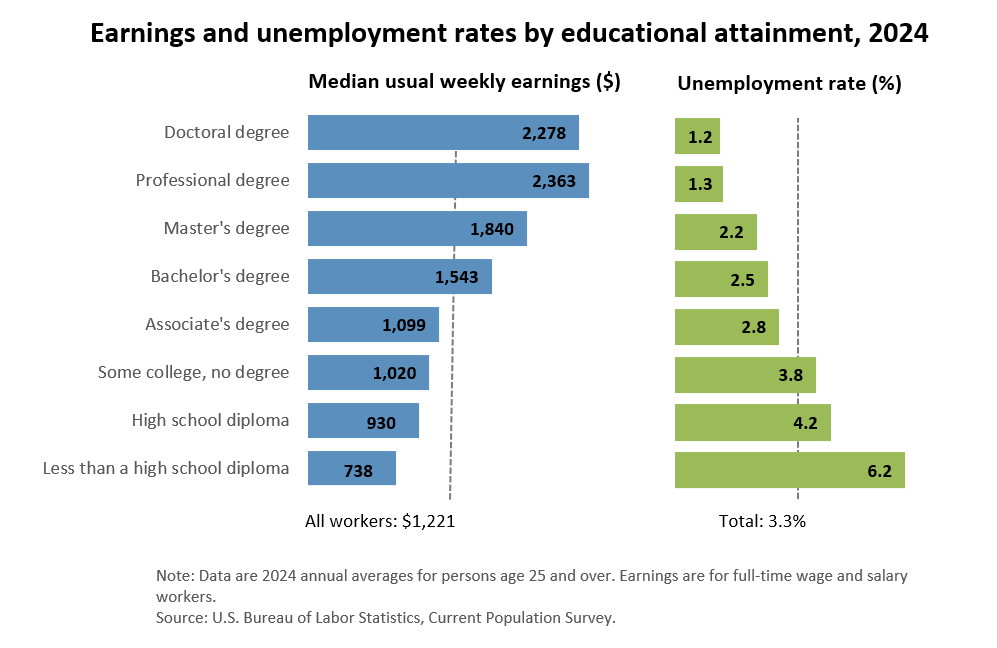
  • Education is highly correlated with income and (negatively) with unemployment. If you search "BLS education pays," you will find the latest link to the following infographic (https://www.bls.gov/careeroutlook/2025/data-on-display/education-pays.htm): 


  • It follows that education may be directly linked to wealth (which is different from income), such as retirement savings. For example, Gallup recently published this figure (https://app.e.gallup.com/e/es?s=831949997&e=3981266&elqTrackId=efd74c1a1b7a40299e524d6e5aa03bea&elq=72212bfdebd7464093a464e8f61c5540&elqaid=15279&elqat=1&elqak=8AF5771A933B3CC341659AEB009DBC1466EE4E2B91DF6C79629EBEEACDFBC5C04086):

...and many other indicators, such as philanthropy, marriage stability, children's academic success, and so on. I intend to bring together here more arguments that, expensive as it may be, higher education is worth the investment.

Thank you for reading!

IHRM Webinar # 25: EDI Research in International Business

On May 25, I had the privilege (and the pleasure!) of moderating the 25th webinar in the IHRM series. I hope you also find it interesting, useful, and inspiring!!

Thank you for your interest!!!

IHRM Webinar #19 - Translating IHRM Research for Practical Impact

Check this IHRM Webinar - Translating IHRM Research for Practical Impact!! Hope you find some excellent ideas to apply while sharing your work (research or otherwise!)...


Sorry that my colleagues haven't yet changed the Clarion logo to PennWest! I hope it will be there the next time I moderate!!

HR's Evolving Roles during the COVID-19 Pandemic

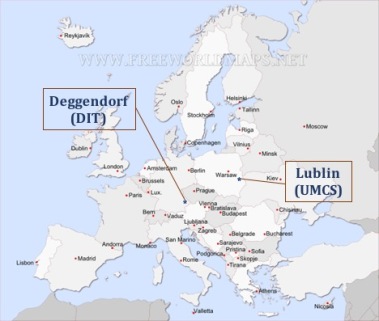
On October 26, I offered this updated version of a talk I gave in September. The original presentation was created to keynote the 2021 Conference for HR Chairs in Lublin (Poland). Here is an announcement that Clarion University posted about it:

https://www.clarion.edu/news/2021/october/hrs-evolving-roles-during-the-covid19-andemic.html

...and here is the presentation:


Blockchains in HR Presentation in Conference Organized by U of South Asia (Lahore, Pakistan)

If there is a silver lining to the current COVID-19 pandemic, it might be that more research is being shared around the world in cost-effective ways. Panelists from 10 countries presented their work on digital business topics that may impact their careers in the near future. The Conference, organized by Dr. Aamir Abbas Chaudhry dealt with Multidisciplinary Research & Perspectives for Innovative Higher Education, with the theme "Career Savvy". Academics based in Australia, Germany, Hong Kong, India, Oman, Pakistan, Romania, Sri Lanka, the UK, and the USA collaborated in this, two-day academic event, free online to the general public (advanced registration required). The registration and summary webpage can be found here.


My presentation started at 9:10 am of Pakistan, which is nine hours ahead of the USA's Eastern time; in other words, I attended the event opening at midnight and started my 30-minute presentation around 12:10 am.

This presentation is about how blockchains (also known as “distributed ledger technologies” or DLTs) are being used for Human Resource (HR). Among the HR applications that are currently available, we find educational credential verification, employment screening, worker payments, automatic contracts, and incident (e.g., harassment or bullying) logging or reporting. I included a basic explanation of how blockchains are the motor that has powered the diffusion of cryptocurrencies, as well as some of the limitations and weaknesses that have thus far precluded more extensive adoption. It was based on a couple of articles that I have developed since 2018, the most recent of which will be published as an encyclopedic entry in the Encyclopedia of Electronic HRM, due this Fall (De Gruyter, Germany: https://www.degruyter.com/view/title/543647).

My work on this topic has been published and presented in recent months both locally and internationally (a recording and ancillaries can be found here: http://drolivaslujan.blogspot.com/2018/11/).

A slice of my Sabbatical experiences in Germany and Poland… With a huge “Thank you” to Jeanne Slattery and Melissa Downes (who edit Hand in Hand) and to all the students, colleagues, and friends we made there…
 Click here to read the article

https://handinhandclarion.wordpress.com/2019/11/09/teaching-in-germany-and-poland-challenging-but-rewarding

El ABC de la Incivilidad en el Trabajo

Hot off the press!! 


Available through Amazon and many other bookstores!!! Thank you, CĂ©leste Grimard for inviting me to this collaboration!! đŸ¥³

#incivility #traininganddevelopment #book #collaboration #tresidiomas #troislangues #threelanguages #antibullying

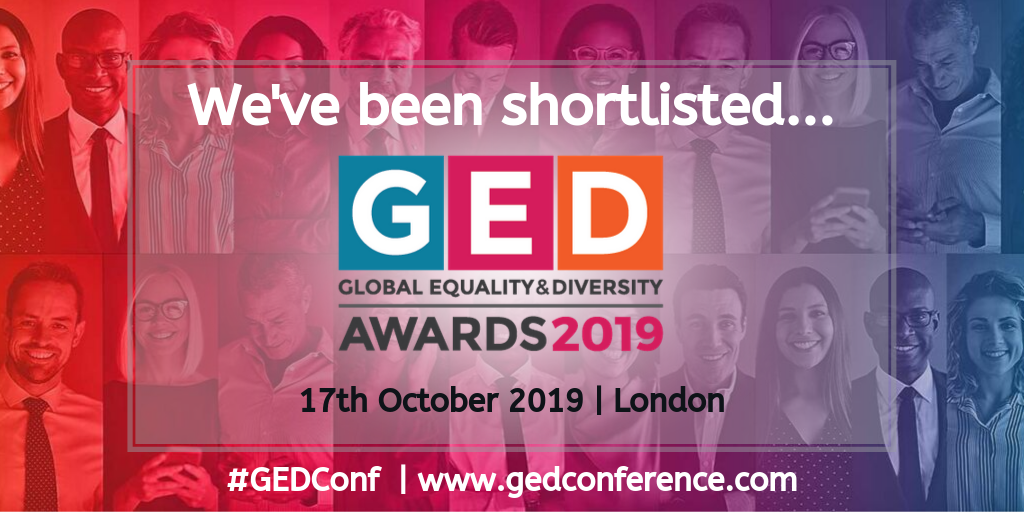
Shortlisted in the Global Equality & Diversity Conference -London 2019!!


It's not every day that my work is "shortlisted"! Or every year for that matter! But yesterday, I received emails from several colleagues with content like this:

The Noon Centre for Equality and Diversity in Business at the University of East London has announced the nominees for the 6th Annual Global Equality & Diversity (GED) Awards, the prestigious yearly celebration that recognises outstanding individuals and organisations developing and adopting new approaches to equality and diversity in business.

...and a few paragraphs below:
THE NOMINEES FOR THE 6TH ANNUAL GED AWARDS ARE AS FOLLOWS:

The Noon Award
  • SAP – Diversity in the Streets Programme
  • WhiteHat
  • MyPlus
  • Lexxic & Neurotalent Unlocked
  • Dr Gregory Burke, AccessAble
  • Nadine Vogel, Springboard Consulting
  • Karen Daly-Gherabi, Springboard Consulting
  • Marshall E-Learning
Inclusive Workplace Award
  • Hachette UK Ethnicity Pay Gap 2019
  • How to be an Inclusive Leader – Liliane Rocha, GestĂ£o KairĂ³s
  • I Believe, I Belong, I Matter; Inclusive IBM
  • Merck Sharp & Dohme (MSD)
  • Acas
  • ISS
Research Award
  • Diversity within diversity management – Andri Georgiadou, Maria Alejandra Gonzalez-Perez, Miguel R. Olivas-Lujan
  • Diversity in Policing campaign – Essex Police
  • Cultural factors contributing to the Gender Pay Gap and inequality in the NHS – Conflux
Impact Award
  • BBC – The 50:50 Project
  • Celebrating Difference by Shaun Dellenty
To find out more about the GED Awards, view the full article here on the Equality and Diversity Hub.
Too bad this conference is taking place so far away from Clarion!! Just being in the shortlist makes me (and my fellow contributors to these books: Diversity Within Management: Country-Based Perspectives and Diversity in Organizations) feel like a winner!!!!

AOM PDW this August!

If you are attending the Academy of Management meeting in Boston this August, please join us for this interactive Professional Development Workshop (PDW)!


Isms in Academia: Exploring how to Foster an Inclusive Culture Inside and Outside the Classroom
Isms in AcademiaSponsored by MED, GDO, IM, and MC
Friday, Aug 9 2019 10:00AM - 12:00PM at Sheraton Boston Hotel in Berkeley AB


Organizer: Andri GeorgiadouEquality Inclusion Diversity (EQUIDY) Center
Organizer: Miguel R. Olivas-LujanClarion U. of Pennsylvania
Distinguished Speaker: S Robert HernandezU. of Alabama, Birmingham
Distinguished Speaker: Kate Marie McCombsFlorida Atlantic U.
Distinguished Speaker: Regina F. BentoU. of Baltimore
Discussant: Andrew MarcinkoAston Business School
Discussant: Christine NittrouerU. of Houston-Downtown
Discussant: Christine Marie MannoU. of Arkansas
Facilitator: Dorothea RoumpiPennsylvania State U.
Discussant: Eugene Agboifo OhuLagos Business School Pan Atlantic U. Nigeria
Discussant: Franklin OikelomeEastern U.
Discussant: Hyacinthe Michael SchwartzOrganizational Behavior Case Western Reserve U.
Facilitator: Jennifer GriffithU. of New Hampshire
Discussant: Lesley ClackU. of Georgia
Discussant: Mami TaniguchiWaseda U.
Discussant: Maureen AndradeUtah Valley U.
Discussant: Muhammad Farrukh MoinTongji U.
Discussant: Rachael GoodwinU. of Utah
Discussant: Rana HaqLaurentian U.
Facilitator: RenĂ©e Smith-MaddoxU. of Southern California
Discussant: Samantha DodsonU. of Utah, David Eccles School of Business
Discussant: Stacy KratzU. of Southern California
Facilitator: Stephanie L. BlackTexas A&M U., San Antonio 
This PDW aims to foster a discussion about how to promote an inclusive culture inside and outside the classroom. The starting point of this discussion is the exploration of inclusion in academia from a broad range of different disciplines, geographical, and theoretical perspectives with the common aim of approaching ways for combating inequality and fostering diversity and inclusion.
Please send an email to the organizers describing your interests and expertise (highly preferred, but not required for attendance).

Blockchains Presentation in Milan

Please click on the following links to access the PowerPoint presentation, the "Fast Facts Sheet," and the paper I presented in Milan about Blockchains in HRM (Human Resources Management):


Blockchains Presentation in Milan (pdf). The slides used for the presentation are in PDF form here.

Blockchains in HRM: Hype or Hit? (pdf). This is a PDF file with the paper presented at the 7th International eHRM Conference in Milan (Nov. 29-30, 2018).

Fast Facts Sheet (pdf). This file includes a definition, a glossary and a timeline with milestones in blockchains.

Do not hesitate to contact me if you have any questions!!

Blockchains in HRM -Clarion Presentation

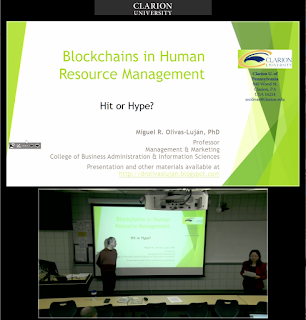
Below is a link to the presentation "Blockchains in Human Resources Management -Hit or Hype?" offered on November 13, 2018.

 Click here to see the presentation


A helpful Blockchains Fact Sheet is also available here.

Thank you for stopping by!