Showing posts with label Education. Show all posts

Are university degrees overrated?

I probably was in middle school (1980s) when I first heard (from a teacher) that "not everyone should try to get a university degree." His arguments were (if memory serves me well) similar to the ones that I hear nowadays (2025):

  1. Too expensive
  2. Many will not graduate
  3. Even if you graduate, you might not find work in your field
  4. There is a need for good carpenters, plumbers, welders, nurses (university degrees were not required for them at the time), secretaries, mechanics, and other "blue-collar" workers, and they make good money faster!

I did not follow that advice. Following my parents' advice, based on their friends' experiences and unfulfilled aspirations (none of my ancestors had even pursued formal education beyond elementary school), I did go to college and earned a Bachelor of Science (Computer Engineering), a Master of Business Administration (international concentration), and a Doctorate (Ph.D. in Management). Intriguingly, the four arguments above seem even more true now than they were back in the 20th Century! 

  • I went to one of Mexico's most expensive universities (thanks to generous scholarships and loans), Monterrey Tec (tec.mx/en); for the first few years, I wondered why I didn't choose a state university instead, but the opportunities I was able to seize there now make me glad about those choices! 
  • I saw many fellow students drop out before finishing their studies. 
  • I have used the knowledge I acquired, but haven't worked as a computer engineer "properly."
  • The last time I paid a plumber, I was well-impressed by his work ethic (even though it was the third time I had called him for the same problem). The studies I have been exposed to give me confidence that specialization is the way to go: I do my job, they do theirs, and each of us charges a market-based price for our services.
Beyond my personal experience, I have set out to compile evidence that my experience is not unique. I have good friends who are advising their children to get a trade-school education instead of going to college. I can see their best intentions. When it comes to my children, I cannot give that advice. If it were up to me, I would encourage every one of my children, my nieces, my nephews, godchildren, and anyone willing to listen to GO TO COLLEGE and EARN THE HIGHEST DEGREE YOU CAN!

Why? Here is some of the evidence supporting my advice:
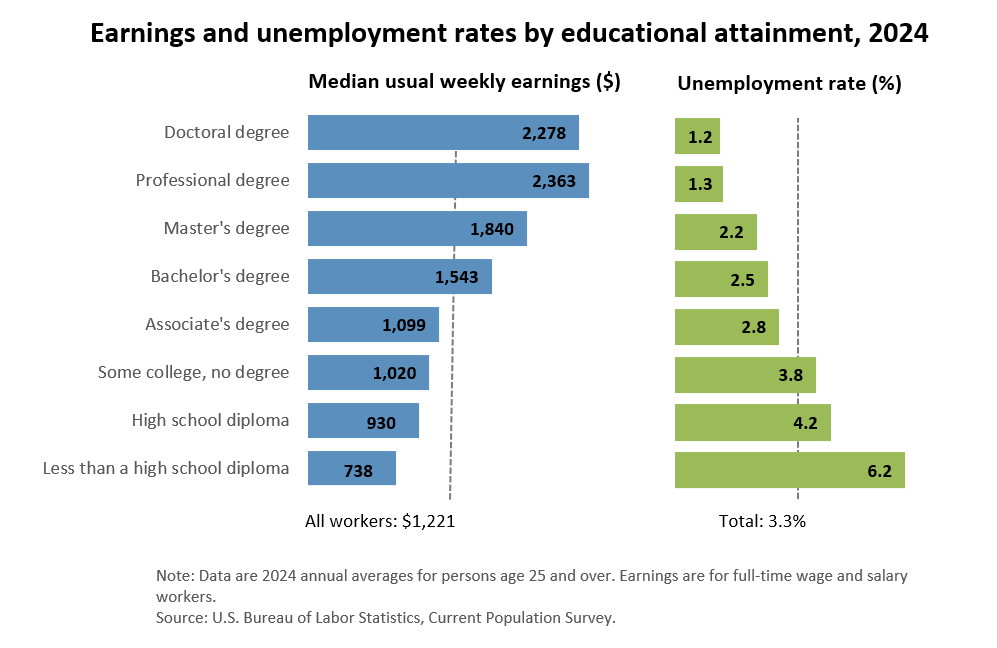
  • Education is highly correlated with income and (negatively) with unemployment. If you search "BLS education pays," you will find the latest link to the following infographic (https://www.bls.gov/careeroutlook/2025/data-on-display/education-pays.htm): 

  • It follows that education may be directly linked to wealth (which is different from income), such as retirement savings. For example, Gallup recently published this figure (https://app.e.gallup.com/e/es?s=831949997&e=3981266&elqTrackId=efd74c1a1b7a40299e524d6e5aa03bea&elq=72212bfdebd7464093a464e8f61c5540&elqaid=15279&elqat=1&elqak=8AF5771A933B3CC341659AEB009DBC1466EE4E2B91DF6C79629EBEEACDFBC5C04086):

...and many other indicators, such as philanthropy, marriage stability, children's academic success, and so on. I intend to bring together here more arguments that, expensive as it may be, higher education is worth the investment.

Thank you for reading!

Time to be grateful? Or pro-active?

Indeed, these are interesting times. Many say it’s a time to be grateful that the Commonwealth of Pennsylvania reduced its financial support by “only 18%” –as opposed to 54% that was originally proposed. Also, it’s time to be glad that the collective bargaining agreement that governs the employment relations between faculty and coaches has not been re-negotiated; what can we expect when the first move by the faculty negotiators was to offer –not even accept—a salary freeze for the next academic year! Time to be grateful that we have jobs, right? After all, unemployment has kept stubbornly above 9% in the past months! (For details, click here.)

But, before we accept this common wisdom, take whatever the Commonwealth and the union offer and resign ourselves to a new contract with salary raises that barely match inflation (if at all!), I suggest we check some of the assumptions behind all of this gratefulness we, faculty members should have.

First of all, while it’s true that national unemployment has remained at the highest level of the decade, I believe we should examine some evidence. Consider the graph in the following link (the Bureau of Labor Statistics will probably be changing it to the most current figures as time goes by):

http://www.bls.gov/emp/ep_chart_001.htm

This figure also clearly ties to us, as faculty, in a number of ways. First, it clearly shows that what we do as teachers has significant economic (as well as cultural and intellectual) value for our students and our state --and we need to remember that and remind others of it. Moreover, this figure demonstrates that, for individuals with faculty-level qualifications, the average unemployment rate in 2010 can be as low as 1.9% for doctoral degree holders or as high as 4.0 for colleagues with only a master’s. It turns out that all those years in school, student loans, etc. do pay off!

Now, before you conclude that I’m suggesting we should all pack up and find jobs in private universities –since our state government is evidently uninterested in continuing to support rural higher education—, I will acknowledge that faculty mobility is not high, especially once one has achieved tenure. Instead, we have to be proactive in these difficult times.

I believe we must start by looking after our own basic needs. Trying to do “more with less” –or even “the same!’’—may be not only insulting, but also dangerous to our health. I already see some colleagues taking on increased workloads as a result of frozen hiring, coupled with recent retirements, smaller budgets for temporary positions, student workers, etc. Burnout may be right around the corner if we don’t take appropriate measures (see Ms. Scholar's column for suggestions clicking here).

Next, our professional development and commitment to research cannot stop! Unless there is a sudden change of heart in Harrisburg, it is quite likely that this is only the first of four, perhaps eight years of reductions in state support for our schools. We must continue to grow professionally. We also need to continue using and honing the rarest and potentially most valuable of our skills, the ability to do research. Not only do publications improve our individual résumés and collective reputation, they might be one of the strongest ways in which we differentiate our university from organizations that charge lower fees but simply cannot offer students what we can when we stay current in our fields. If our skills and reputation take a hit in the next few years, we will be unable to convince the shrinking student population that our university is worth attending, or find alternate sources of employment, should the need arise.

I am sure there are other ways to be proactive in these difficult times. If we work together to be proactive, we can be grateful to each other. I hope we do inspire and help each other find ways in which we will not only survive but thrive during these interesting times.