Showing posts with label teaching. Show all posts

Why Can’t I Choose My Teammates in Your Classes?

Students often ask me why they can’t pick their own teammates in my classes. In many classes, choosing your own group is common, and I used to prefer it too. But over time, I noticed that most students select friends or people who seem similar to them. This is a normal human tendency—called similarity or affinity bias—but it can accidentally create cliques or limit opportunities to meet new people or work adequately with individuals that are different from us.

To give students a more valuable learning experience, I moved to an evidence‑based system where I assign teams. This lets you work with classmates you might not interact with otherwise. Diverse groups—whether in gender, background, major, skills, or perspectives—better mirror real workplaces. In most jobs, you don’t get to choose your early‑career teams, and you will often collaborate with people who have very different experiences from yours. Practicing this in college helps you become a stronger, more adaptable teammate in your professional career.

Why I Use Assigned, Diverse Teams

In this course, I build teams using specific demographic and behavioral criteria rather than allowing self‑selection. Research shows that diverse groups outperform more homogeneous ones on complex tasks and that assigned teams often share work more fairly, avoid “social loafing,” learn more from one another, and benefit from a wider mix of ideas.

My Goal

My goal is to prepare you for professional environments by giving you practice working across differences. By collaborating with a broad range of peers, you develop important communication, teamwork, and conflict‑management skills that employers value highly.

The Research Foundation

Reduced "Social Loafing": Research shows that instructor-assigned groups often exhibit higher accountability than friend-based groups, leading to more equitable work distribution (Maguire & Keceli, 2023).

Knowledge Spillovers: Interacting with peers from different demographics and disciplines has been shown to improve individual learning outcomes and exam performance (Hansen, Owan, & Pan, 2015).

Collective Intelligence: A team’s success is driven by “Collective Intelligence”—a factor enhanced by social sensitivity and a wide range of perspectives rather than just the individual IQ of its members (Janssens, Meslec, & Leenders, 2022).

References

Chapman, K. J., Meuter, M. L., Toy, D., & Wright, L. K. (2006). Can’t we pick our own groups? The influence of group selection method on group dynamics and outcomes. Journal of Education for Business, 81(3), 150–157. https://doi.org/10.1177/1052562905284872 

Dachner, A. M., & Beatty, J. E. (2023). A selected review of exemplary diversity articles published in the Journal of Management Education. Journal of Management Education, 47(2). https://doi.org/10.1177/10525629231178798 

Hansen, Z., Owan, H., & Pan, J. (2015). The impact of group diversity on class performance: Evidence from college classrooms. Education Economics, 23(2), 238-258. https://eric.ed.gov/?id=EJ1048197

Janssens, M., Meslec, N., & Leenders, R. T. A. J. (2022). Collective intelligence in teams: Contextualizing collective intelligent behavior over time. Frontiers in psychology, 13, 989572. https://doi.org/10.3389/fpsyg.2022.989572

Maguire, D., & Keceli, Y. (2024). The impact of formation and diversity on student team conflict. Active Learning in Higher Education, 25(3), 409-423. https://doi.org/10.1177/14697874221144998 


Students' Comments, December 2025

The following are some of the comments left by students who took my classes in the Fall of 2025. They knew that (1) their names would not be revealed, and that (2) I would not read them before I reported final grades. In other words, they did not post this to flatter me and receive a higher grade!

Dr. Olivas–Lujan is an excellent professor who seems to care about the material and the students.

I really enjoyed this course. While it was challenging at times, there profession [sic] provided clear instructions and feedback to ensure student success. This course was well put together and enjoyable for that reason.

Dr. O has provided excellent feedback regarding assignments and where we can improve our work. He is understanding and supportive of his students, and responded promptly to questions about coursework.

The feedback was beneficial, and I can tell Dr. Olivas–Lujan took the time to leave personalized feedback. The announcements also were helpful to keep us on track. 

During this course it has made me reflect on people and managing, Dr. Miguel Olivia's–Lujan has done an amazing job with this course.

Organizational Design and change management were very insightful courses especially when mixed with these practical virtual simulations within the Harvard University . The Learning materials were very challenging and high level . For the first time of my life , I have discovered a Doctor who really deserves the title of Doctor. He is a very savvy scholar and intellectual with a good sens of humility and empathy.

We are at the end of the semester and one thing I'm sure about , I will miss Dr O!

Dr. O truly cares and instructs content that is translatable to the professional environment,

He was always answered questions and emails in a timely manner and was willing to help when needed.  
He was very easy to get in contact with. He had good assignments...

He was always there to help

I think the team projects were good to work with people

He is very easy to get ahold of, and he is always willing to assist students with issues.

I think all aspects of this class will be utilized in my everyday happenings and I appreciate how well the Professor taught the class and was very helpful whenever we needed him.

Dr O provided a lot of instructions and was always available to assit.

Love this course 

Professor Lujan's course is very well structure to follow. It is very beneficial to help my learning. I've learned more regarding hazards that were located around a workplace.

He was always there to help.

I liked the group projects and I think they were fun

The most beneficial aspects for me were the discussions and presentations created by students. Many classes feel like there is an immense amount of information trying to be crammed into a week, and then the next week includes all new information, leading to last week's assignments to be forgotten quick. Using the discussions to reflect on information that we learned before helped the topics really set into my brain. The presentations included real world examples that helped me realize the necessity of each topic in workplaces.

I thought the course was very organized. The discussions with our groups was beneficial to me because I got to emphasize what I learned while also understanding what my group learned.

I think the DB [discussion boards] were beneficial. 

I felt that the class was well structured for learning. I don't think there's anything that I would change in the course to make more beneficial.  

I think as an online student, this class is very well designed the way it is  

Loved the course  

There is nothing to improve, I believe, everything is perfect.

Of course, there was a couple of students who left negative comments, but that's the nature of the job. The comments above really make my day (my year!) and motivate me to give my students even more attention and help their professional preparation and growth! 

Gemini-generated image of "a happy university professor in his 50s"
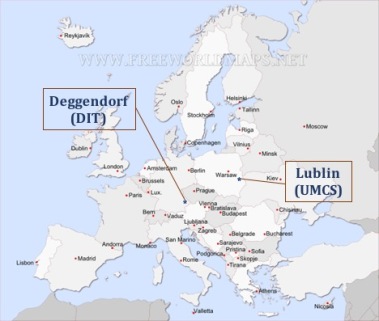
A slice of my Sabbatical experiences in Germany and Poland… With a huge “Thank you” to Jeanne Slattery and Melissa Downes (who edit Hand in Hand) and to all the students, colleagues, and friends we made there…
 Click here to read the article

https://handinhandclarion.wordpress.com/2019/11/09/teaching-in-germany-and-poland-challenging-but-rewarding